Sample Business Mobile Coverage Report for UK Businesses
Choosing a business mobile network on headline claims alone is risky. A network that works well in one area can perform poorly at another depot, office, warehouse or staff location.
This page explains the report format and includes a dated, anonymised example from a verified Ofcom lookup. Always run a fresh check for your own address.
Compare predicted mobile coverage from EE, O2, Vodafone and Three at your business address.
What does a sample coverage report show?
A report identifies the selected property and shows the available predictions for EE, O2, Vodafone and Three together. It preserves equal ratings as ties rather than naming a preferred winner.
The category key below follows Ofcom’s API specification. The worked example shows how those categories are compared for a single property, with its identity withheld.
Categories described in Ofcom’s API specification
- 4
- Good in-home and outdoor
- 3
- Variable in-home, good outdoor
- 2
- Good (outdoor only)
- 1
- Variable (outdoor only)
- 0
- Poor to none (outdoor only)
- Unavailable
- Missing, conflicting or unrecognised value; no category is inferred.
One blended prediction per network for typical usage. The numeric levels are categories, not a speed test or four separate voice/data scores. Equal levels are tied.
Worked example: equal ratings remain tied
This category combination was observed in an authenticated Ofcom lookup on 9 November 2026. The property identity is withheld. This is a dated explanation, not a current result for your address or a recommendation for an area.
EE
Variable in-home, good outdoorOfcom level 3 of 4
O2
Joint highestGood in-home and outdoorOfcom level 4 of 4
Three
Joint highestGood in-home and outdoorOfcom level 4 of 4
Vodafone
Good (outdoor only)Ofcom level 2 of 4
O2 and Three have the same highest available category. Both remain tied; neither is preferred. EE is variable in-home with good outdoor coverage, while Vodafone is good outdoors only in this example.
These categories do not provide separate voice and data results or measured speeds. An unavailable value would be shown as unavailable and would not be treated as the lowest category. Check the selected address and confirm practical service where your team works.
This helps businesses avoid choosing a network based purely on brand familiarity, national advertising or assumptions. To understand the report method, see how our coverage checker works.
Why businesses ask for this before ordering SIMs
Businesses usually come to us when they want more certainty before moving numbers or starting a new mobile contract.
Typical reasons include:
- A current provider performs badly indoors
- Different depots need different networks
- Sales staff, drivers or engineers work across mixed locations
- A business wants to reduce the risk of failed deployment
- Decision makers want evidence before approving a switch
For multi-site businesses, a coverage check can be far more useful than relying on a single national coverage claim.
How to read a selected-property report
When reviewing a report:
- Confirm that the address and UPRN match the property you intend to check
- Read all four network categories for that same selected property
- Treat unavailable values as missing evidence, not as poor coverage
- Two networks may have the same category and are then displayed as tied
- Repeat the lookup for each location instead of extending one property’s result to another site
That is why Business Telco does not force every customer onto one network.
We look at what is most suitable for the actual business location and usage pattern. For general business requirements, see our EE vs Vodafone business mobile comparison.
Archived legacy report layout
Archived legacy screenshot — this predates the 4G/5G migration. Its four voice/data measures, total out of 16 and preferred-network tie-break are the original legacy scoring, not the current categories or a current lookup.
The current-method worked example is shown above. The image below remains an archive of the earlier checker.
View archived legacy screenshot — not the current report
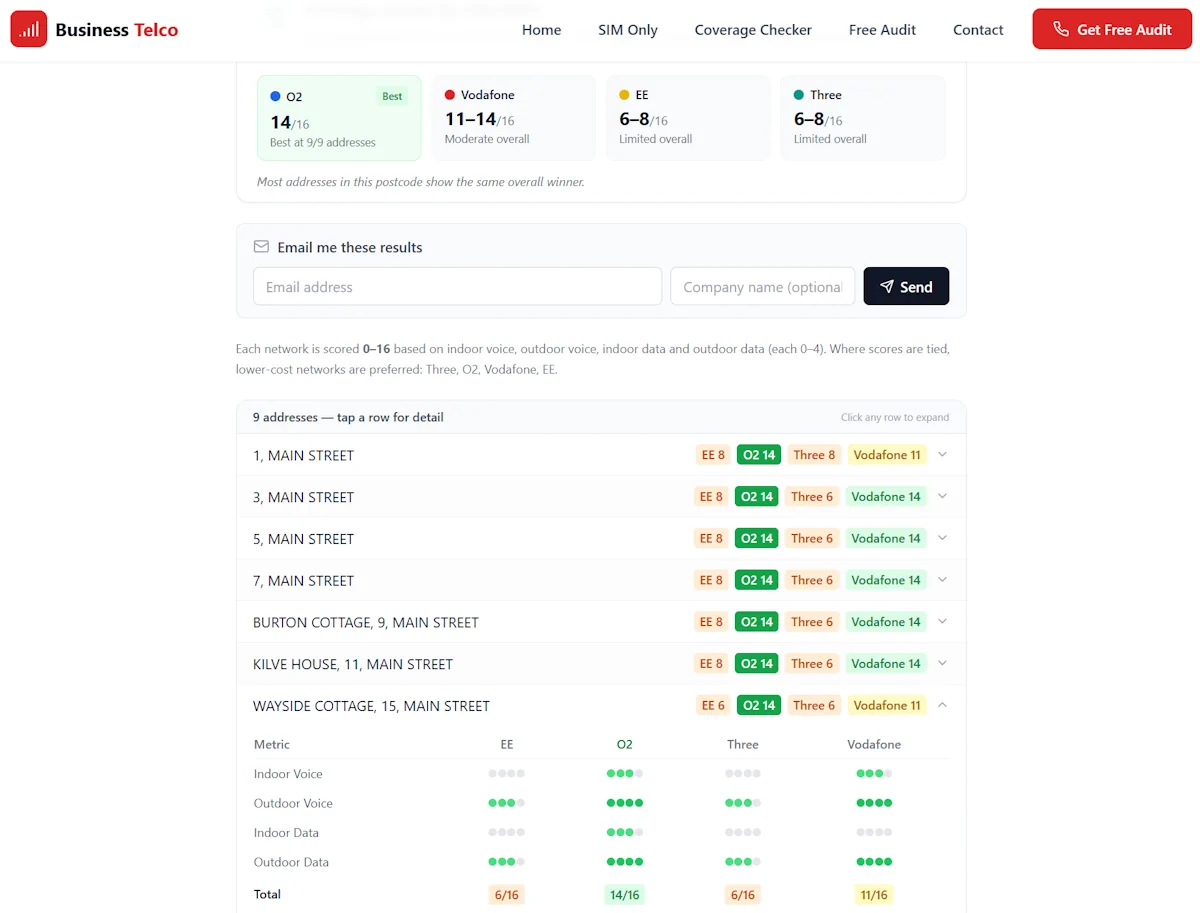
Historical example only. Existing legacy screenshots are not recalculated or presented as current results. Use the category table above to understand the current method.
- This archived image shows the former /16 scores for all four networks.
- Results can vary within the same postcode, which is why a single headline coverage claim is not always enough.
- The old expanded view separates voice/data and indoor/outdoor fields; the replacement API does not supply those measures.
Why this matters before signing a business mobile contract
Changing business mobile provider can be disruptive if the wrong network is chosen.
A weak decision at the start can lead to:
- Poor indoor signal
- Frustrated staff
- Missed calls
- Unreliable data sessions
- Wasted time changing networks later
A coverage-led approach helps reduce that risk.
Business Telco supports UK businesses with practical mobile advice, clearer comparisons and contracts built around real-world usage — not just sales scripts. For a wider overview of networks, tariffs and how to compare them, see our business mobile plans guide.
Want a coverage check for your business?
If you are reviewing business SIM-only plans, replacing an existing provider, or deploying mobiles across one or more sites, we can help you assess the likely network fit before you move.
Use our coverage checker or contact Business Telco to discuss your locations.